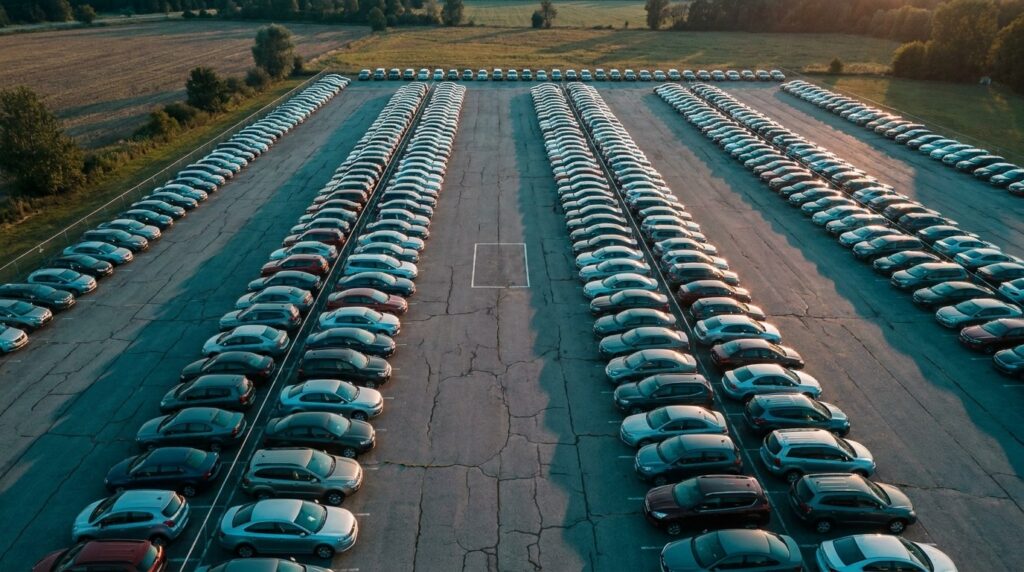
There are two clocks running in every used car department, and most stores only watch one of them.
A customer-sourced car hits retail in a median 21 days. A car with no customer history takes 33 to 39. Both clocks tick at about $32 a day in floorplan interest, insurance, lot cost, and depreciation. Only one of them stops early.
The fast lane is faster than you think
Trades don’t linger. Across 250,677 trade-ins, 88.7% resold within 180 days, and the median trade-to-resale time was 19 days. The car arrives, it recons, it sells. Half are gone before the first floorplan cycle bites.
The auction car runs a different route. It spends days on a truck before day one on the lot even starts. Then it recons with no service history to guide the inspection. Then it waits with every other commodity car that came off the same lane.
The 12-day tax, per unit
Take the gap at its narrowest: 12 days, at roughly $32 a day. That’s about $400 per car. At the wide end, 17 days, it’s closer to $550. This charge appears on no invoice and shows up nowhere in the deal jacket. It just quietly comes out of the gross, on every auction unit, every time.
Stack it with the numbers from Article 1: the $542 gross gap, the buy fee, the freight. The days are the part everyone forgets, and they’re worth almost as much as the fees.
The bigger number: capital velocity
Per-unit math understates it. Think in turns.
Money parked in cars that sell in 21 days turns about 17 times a year. Money parked in cars that sell in 33 days turns about 11 times. Same inventory dollars, six extra selling cycles. A store running $500,000 in used inventory doesn’t need more capital to sell more cars. It needs faster cars.
Where slow cars go to die
The tail of the slow lane is where the real damage lives. Cars that age out don’t just cost holding days, they exit through the wholesale door. And we’ve measured those exits: the customer-sourced car that misses loses about $50. The auction-lane car that misses loses $290 to $494. The slow lane produces more of those exits, and each one hurts six to ten times more.
Aging policy debates, price-drop cadences, 45-day meetings: all of it is managing a symptom. The disease is buying cars that start slow.
Next up
There’s one used car that outruns even the trade-in: it grosses 44% more than the average unit, it’s a guaranteed one-owner with full history, and most stores capture only a fifth of the ones they’re owed. Next week, the lease return.
This series is built on real DMS data: 250,677 trade-ins, 371,227 used retail sales, and 86,349 lease maturities across roughly 100 rooftops, 2024–2025. Every “keep” rate we publish is matched same-store only, which means the true numbers are higher than what we print.